Bilha Bashan: Summary from a meeting on December 2013 at Dov Shai’s home

This post was initiated by Mrs. Shulamit (Shuly) Druckman-Levi on Facebook. Shuly – thank you a lot!!
The summary was written by Dr. Bilha Bashan. Thank you Bilha.

AttendingDov, Vera his wife, Shlomit Levy his daughter , Baruch Eylon (my cousin), my sister Yetka huller and my daughter Ariel.

Origin – The family moved from Galicia to Bukovina around year 1800. They had no specific professions. The name Drukmann was due to the fact that he was a “Sofer Stam”- religious scribe.

Michael (Yechiel Mechel) received a large plot (~12,000 hectares) in a village called Hilcze, about 7 kilometers from Banila. Banila was a deserted place despite its fertile soil and pastureland. They grew a lot of corn.

Dov Shai (Schertzer– S.D) heard these facts from his mother Lotti (Leah Schertzer, born Druckman).

Grandmother Sarah Druckman, Michael‘s wife, died at the age of 101.

Michael was active in the community (עסקן). He was involved in a board committee of a trade vocational school in Chernovitz. When the schoolwas bankrupt, Michael was placed in prison.

Sarah, his wife, went to Vienna since she asked for and received a meeting with the Caesar. Sarah reached a financial arrangement with the Caesar, to pay the Caesar to release Michael from prison. Sarah sold all their ridge to the Adlersberg family (not related to us, a different Adlersberg family). Michael was released.

He was not aware that almost all the ridge was sold and got a heart attack. (according to Dov Shai‘s family saga book, he writes that discovering that the ridge was sold, instigated the heart attack – S.D)

Until 1848, 148,000 estates were owned by Jews. In 1850 the Germans arrived and received plots of land.

At the British library in London there is archival information about Bukovina, and in Augsburg too (Germany – S.D).

Henia DruckmanMichael’s daughter, married an Adlersberg HaCohen. She bought a plot of land in Banila. Berl (Henia’s brother -S.D) received the estate.

Dov Shai was born in 1927, in Hilcze. His father Berl sold the estate and they moved to Banila. They had a beer distribution agency.

Savta (grandmother – S.D) Bass’e had a Kosher Mehadrin restaurant/boarding house (Inn – S.D) with a few rooms. During the summer when people came from Chernowitz for vacation they stayed there. She also catered for small events (20-30 people).

Avraham and Betty were the ‘two intelligent ones’. Avraham Gertler was an accountant in Seletin, 76km from Banila. (Michael Druckman – Berl’s son, lived in Seletin with his wife Jeannette Sussman and daughter Chaya – S.D).

(His sister – S.D) Betty studied in Beit-Yaakov. The community opened the school (for girls – S.D) and my mother Betty taught there.

Joseff (יוז’יו) – The only one that had a profession – as a hairdresser,  was  Yosef Gertler, their brother.

(There were many “Wagon Owners” in Banila (wagon taxis – S.D).

The Druckmans were ‘snobs’. They were the “Levi”, honored/privileged, the elite of Banila.

There was a main synagogue in Banila, where the rabbi prayed. Uncle Shmuel, Henia Adlersberg’s brother, had a seat in the East (facing East   

Duniu Druckman (David Druckman – S.D’s grandfather – remark is regarding the family tree Duniu made which Dov Shai gave Bilha on her visit – S.D).

A recipe for Totch: (We tasted   in the meeting the special Drukmann Toch)

3 eggs, half self-rising flour (measurement not mentioned – S.D), 1 packet of yeast, 5 large potatoes, 1 teaspoon of salt. Grate the potatoes (do not squeeze out liquids), add flour, yeast, salt and eggs. Leave to rest for 2 hours then place in a large oven baking pan for one to one and a half hours (temperature not mentioned – S.D).

* Note – Where I added my remarks, I placed my initials (S.D = Shulamit Druckman) to show it’s not part of the original text.
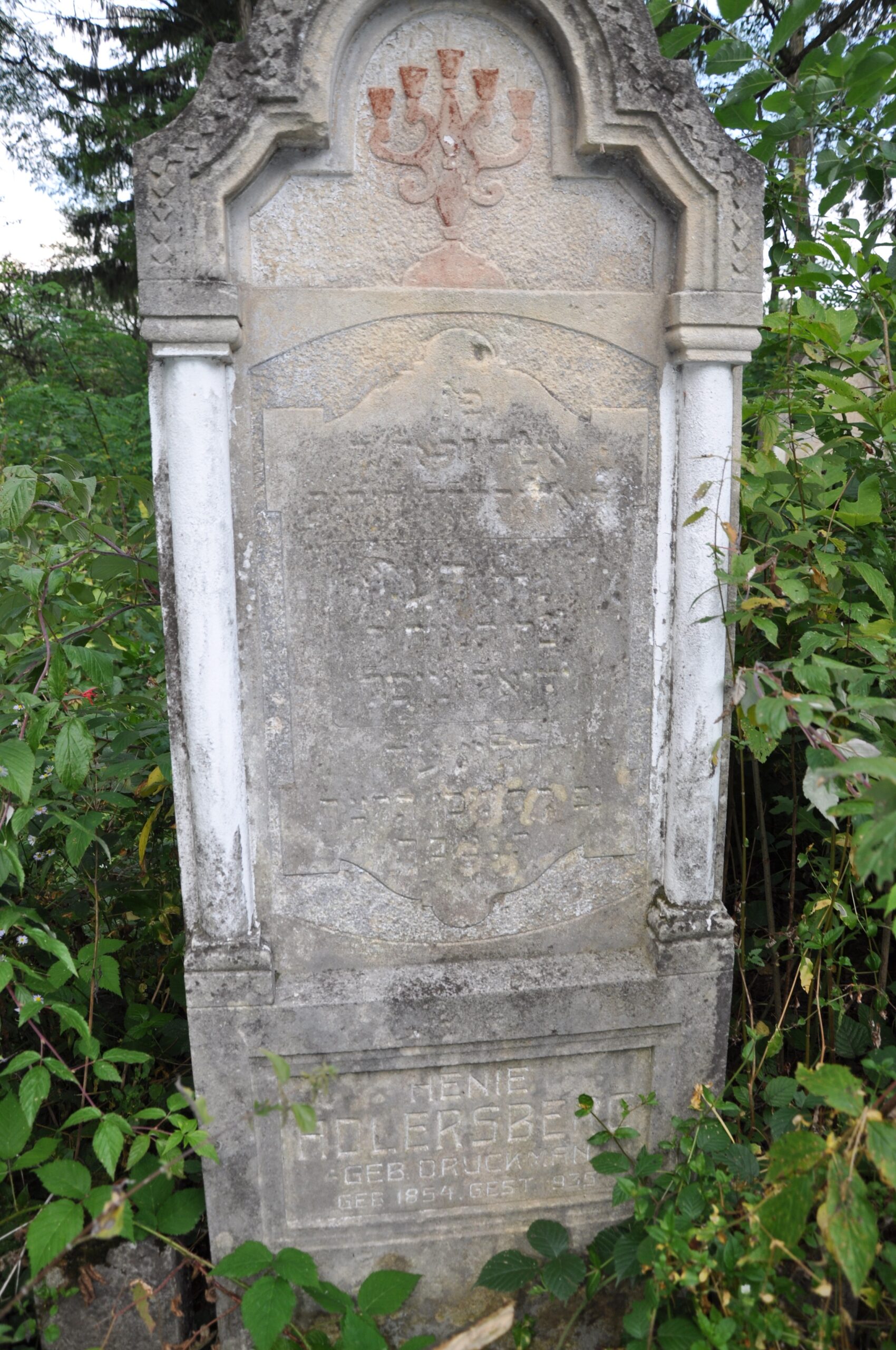
Baruch Eylon’s grand-grand mother’s grave in Banila pe Siret – by Baruch Eylon 19.5.2021

My family lived in Banila pe Siret before WWII. My Parents lived there and were deported to Transnistria in 1941. En route to Mogilev my grand mother died and was left along the road….

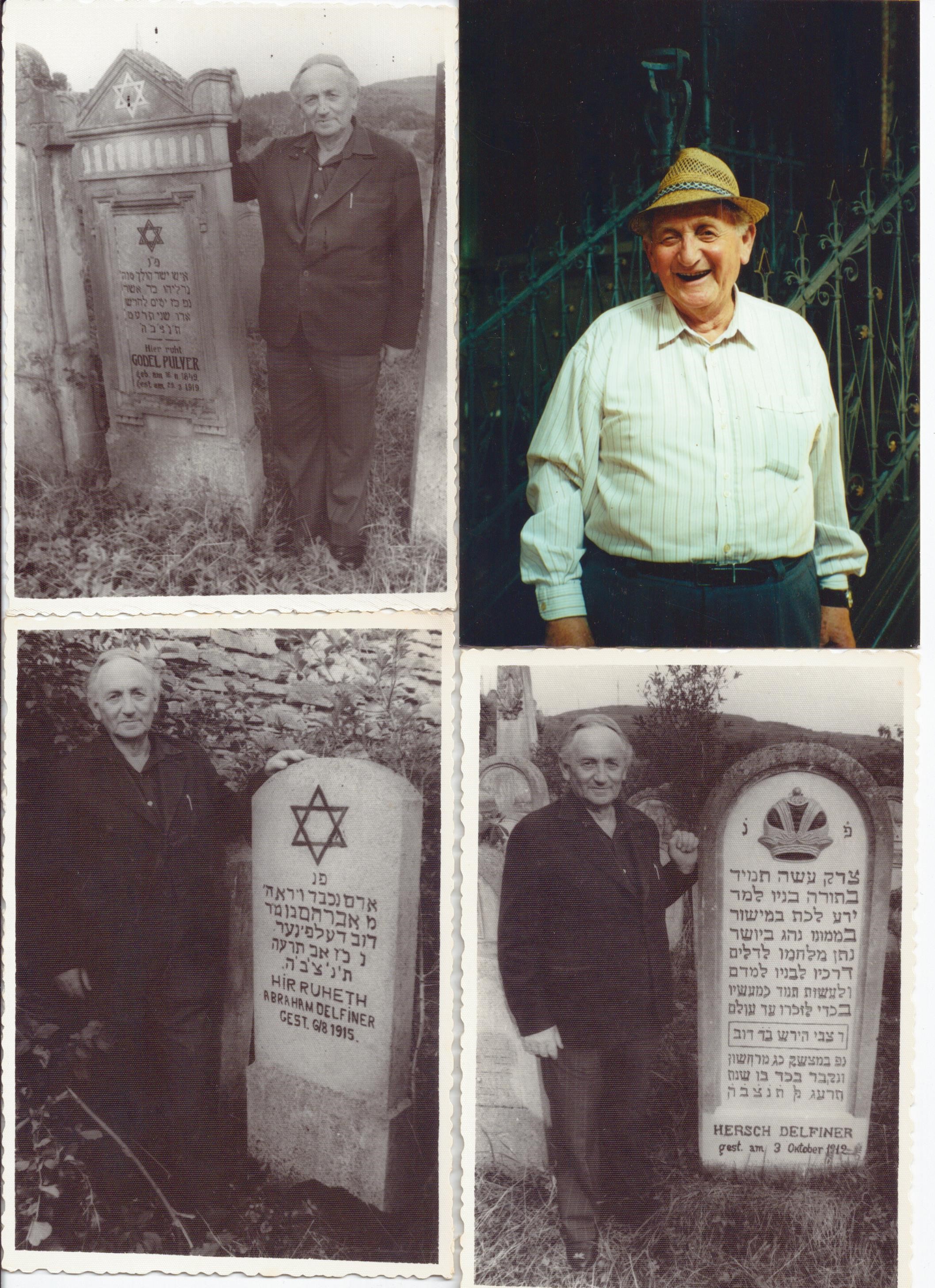
Her mother – Henia Adlersberg lived in Banila and was burried there. I visited Banila in 2013 and then in 2016 but did not find her tombstone. In 2017 Mr. Naftali Zloczower visited Banila and took pictures (See http://www.eylonconsulting.com/bukovina/blog/?p=2838 ). This week – May 2021, Mrs. Shulamit Druckman-Halevi reviewed the pictures and identified the gravestone of my grand-grand-mother and informed me about her finding.
It turns out that she and me have roots from the Druckman family.

Thanks Naftali Zloczower for taking the pictures and sharing them and to Shuli for bringing it to my attention.

Here is the photo.

The speaking stones of Siret – by Dr. Thomas Weggemann

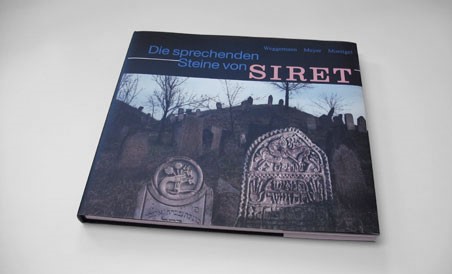
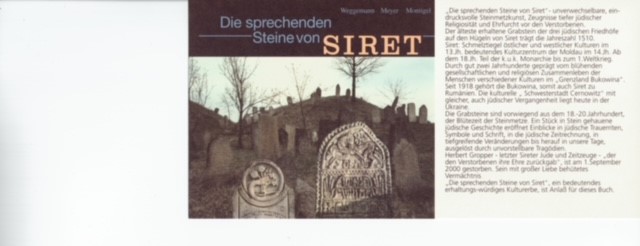
This book by Dr. Thomas Weggemann concentrates on the cemetery of Sereth/Siret. It is called ”Die Sprechenden Steine von Siret” – “The speaking stones of Siret” with stories about it. Its International Standard Book Number is ISBN3-902249-01-3.

www.dr.weggemann.at/siret.htm    ISBN 3-902249-01-3 

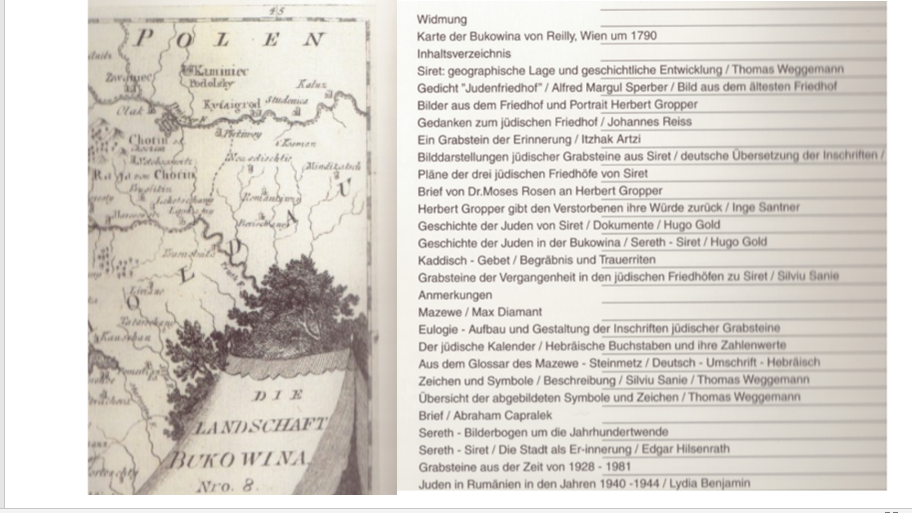
The Table of Content of the book and its cover page are shown below.

Ordering the book: Dr. Thomas Weggemann,
A 6700 Bludenz, Werdenbergerstr. 47, Austria.
email: thomas.weggemann@aon.at

H. Gropper

Suceava – Cemetery and School Projects by Dr. Lily Pauker

Dr. Lily Pauker’s family is from Suceava, Bukovina, Romania. To preserve her family’s memory and that of the Jewish community she performed several projects, which are provided here as PPT and Video clips.

Here it is:
1. Cemetery Project Video – https://www.youtube.com/watch?v=BrBZ47zLYq0&t=14s (Hebrew speaking)
2. Cemetery Project PPT – http://www.eylonconsulting.com/bukovina/blog/wp-content/uploads/2020/02/FINAL-FINAL-LILY-CIMITIRUL-DIN-SUCEVA-1.pdf

2. School Project – https://www.youtube.com/watch?v=CQI_q2OYaI8&t=25s (Speaks Romanian)

3. The holocaust of Suceava Jews – https://www.youtube.com/watch?v=BrBZ47zLYq0&t=282s

Many thanks to Mrs. Lily Pauker for all her efforts and dedication.

Written by Baruch Eylon 20.2.2020

Monument of the Verkhni Petrivsti (פטראוץ) Synagogue by Joel Fox Jerusalem, Israel 6/2019

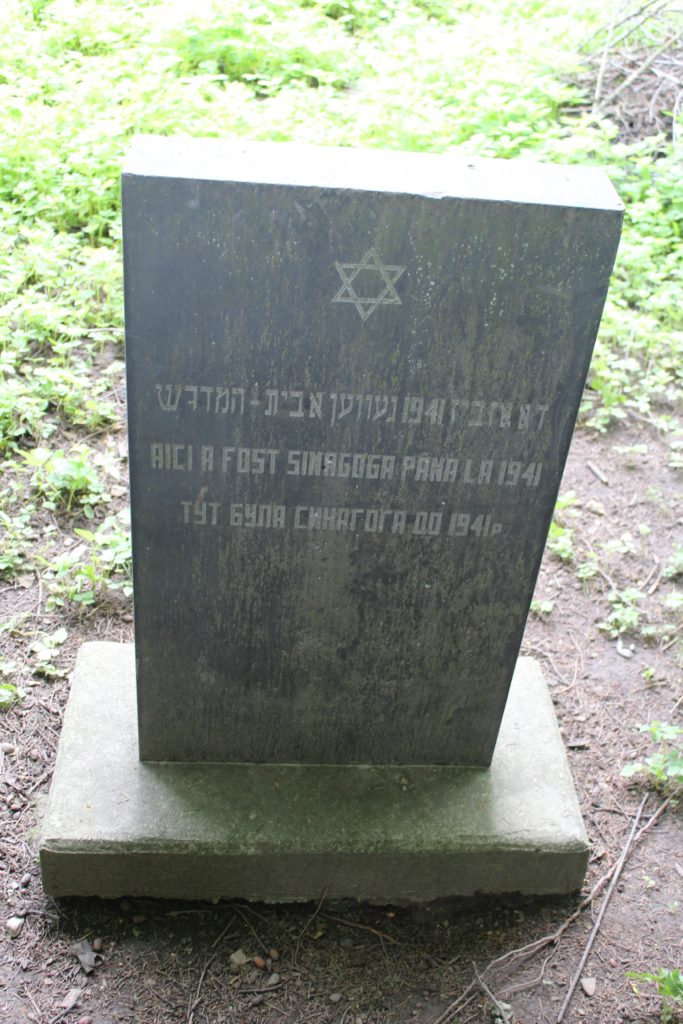
My fatehr and I traveled to Verkhni Petrivsti (פטראוץ) Ukraine in June, 2019. We were led by local villagers to a monument on the site where the synagogue stood. The monument is behind a cement wall in the back yard of a private residence. It cannot been seen from the road and its existence is not known to all the villagers. 

The estimated coordinates of the monument are 48.046885,25.744063 .

Picture of the monument

Tzibulevka mass graves by Joel Fox Jerusalem, Israel 6/2019

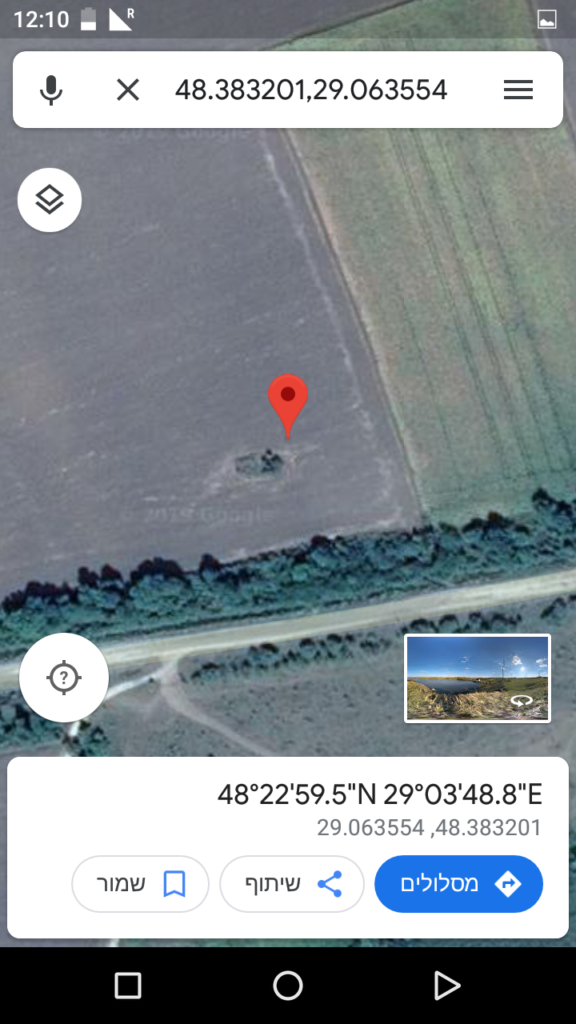
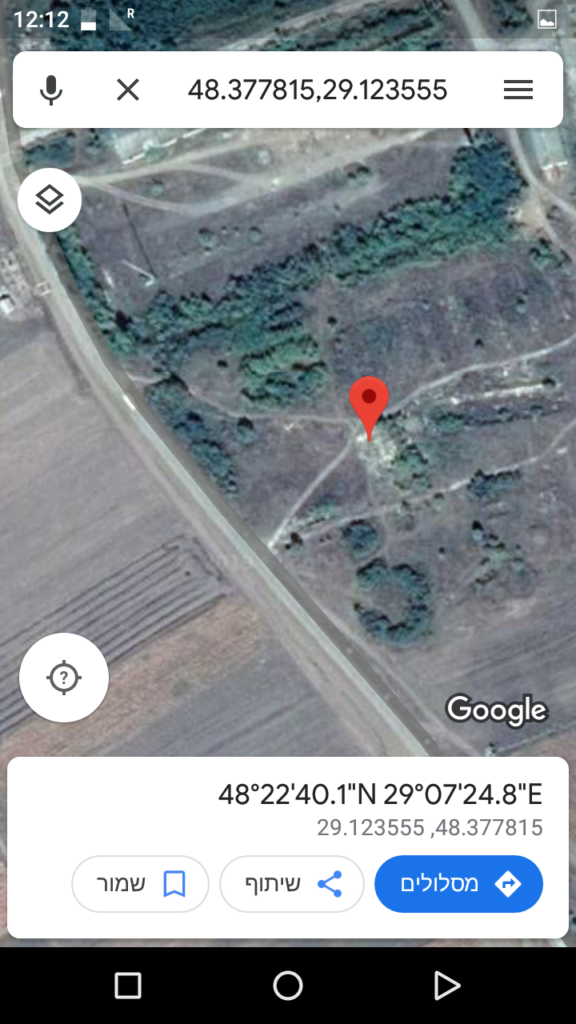
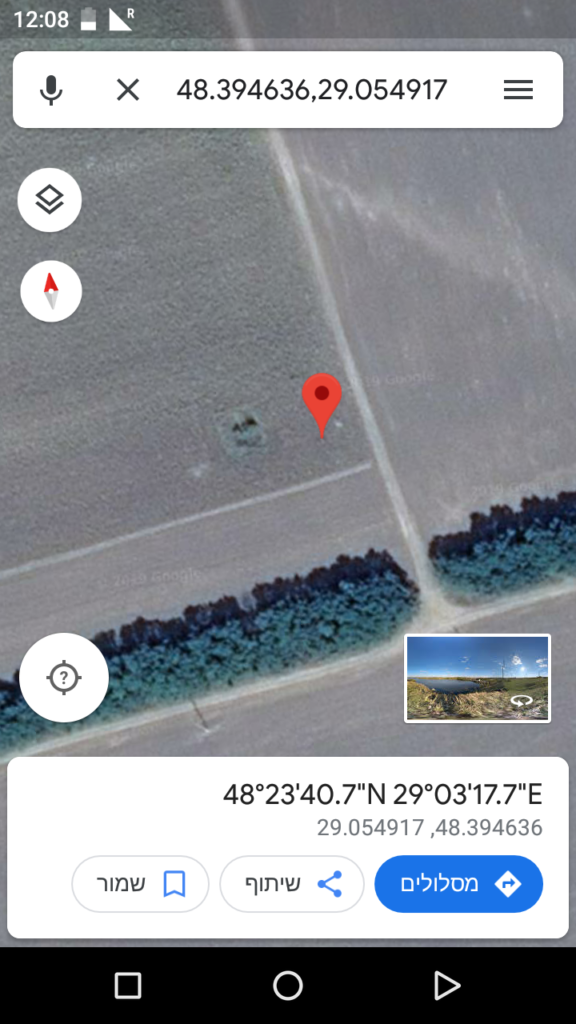
My fatehr Moshe and I traveled to Tzibulevka, Ukraine June, 2019. There are at least 3 momuments/memorials placed on 3 mass graves. Their coordinates are as follows: 48.383201,29.063554 , 48.377815,29.123555 , 48.394636,29.054917 .

Looking at sattelite images through Google maps you will notice a small patch of trees in the middle of vast fields near the coordinates above. The monuments are between those trees.  for more details regarding the sites please contact me – Joel Fox – foxisus@gmail.com .

Jewish cemetery of Chudei – Joel Fox, Jerusalem, Israel 6/2019

My father and I traveled to Chudey Ukraine in June, 2019. The cemetery has been fenced by ESJF – see:   https://www.esjf-cemeteries.org/project/chudey/. I documented about 200 headstone that are now available on the JOWBR database. See https://www.jewishgen.org/databases/cemetery/jowbrshow.php?ID=UKR-08332

Here is the list of the headstones

Partial list of Inhabitants of the Storojinets Ghetto in August 1941 – by Naftali Zloczower – 6/2019

Naftali Zloczower, Kibbutz Kfar Charuv, Israel
In September 2017, my wife, Nava, and I made a roots trip to Bukovina, including Storojinets (Storozynets), the hometown of my parents and grandparents. The trip was enlightening, exciting, moving and inspiring.


One of the top highlights of the trip was our visit in the Czernowitz Archives (State Archives of Chernivtsi Oblast). We were presented with cardboard files containing listings of the inhabitants of the Storojinet Ghetto in August of 1941, shortly after the Jewish Ghetto was established by the Romanian fascists in July, and shortly before all these Jewish residents were marched and hauled to the camps of Transnistria in October-November.

We had very limited time to go over the many pages of listings, since we arrived close to the closing hour of the archives. Even though we were allowed to stay a little longer than the official closing time, we were under pressure and were not able to view all the lists (at the last minute they brought to us the files from my great grandparents’ village, Banila, but we did not have the time to even open the files).

As we quickly went over the files, looking for familiar names, we found the names of almost all my relatives who were in the Ghetto at that time. Using my camera, I photographed only pages containing last names that looked familiar to me (relatives and family acquaintances). Even though the pages I photographed included only part of the many pages of listings, they contained many names of Ghetto residents.

I decided to compile and prepare a printed list of the residents appearing in the photographed pages, not realizing what a difficult task I took on myself. The lists were hand-written by different clerks, each with his/her personal handwriting. The language of the listings was Romanian, and some of the scripts were unfamiliar to me.

Not being a doctor or a teacher, who are used to reading barely legible or illegible scribblings, it was very difficult for me to decipher many of the names and words. Street names and names of towns changed since 1941, so it is difficult to check these out. There were different spellings to the same names, making it even more difficult to decipher them. To add to the difficulties, some of the photographed pages were not in perfect focus, making the names even more illegible.

It was extremely difficult to decipher the names of people, streets, towns, and regions, but I used different means and methods in trying to accomplish this. I think I was successful in deciphering many of the illegible names, but I am sure there are still many mistakes in the list I compiled.

The city of Storojinet, the second largest in Bukovina in 1941, was and still is the administrative center of the County of Storojinet. The original lists give the names of the town/city and county or region where each of the listed people was born. In my lists, for people born in towns in Storojinet County, I just wrote the name of the town.

For people born in towns/cities not in Storojinet County, I wrote the name of the town/city and, in parenthesis, the name of the county or region where they were born.

The original lists showed the age of each person, and I added to the age the calculated approximate year of birth (1941 – age = year of birth). I also marked known relatives and family acquaintances.

In this document, I include a photographed copy of one of the original pages, as a sample page, and translations of the Romanian column headings of the original table.

If you wish to have a copy of an original page containing specific names, please write to me ( nzlo@outlook.com ) and I will send you a copy.

Chudei Jewish Memorial and Cemetery – provided by Philip Moses of Vancouver, Canada – 6/2018

This post documents the site at Chudei, (also known as Ciudin by the Jews in 1940)  Ukraine (formerly Romania) based on a visit by me, Philip Moses of Vancouver, Canada  and my brother Richard Moses of Ottawa, Canada on May 10, 2018.

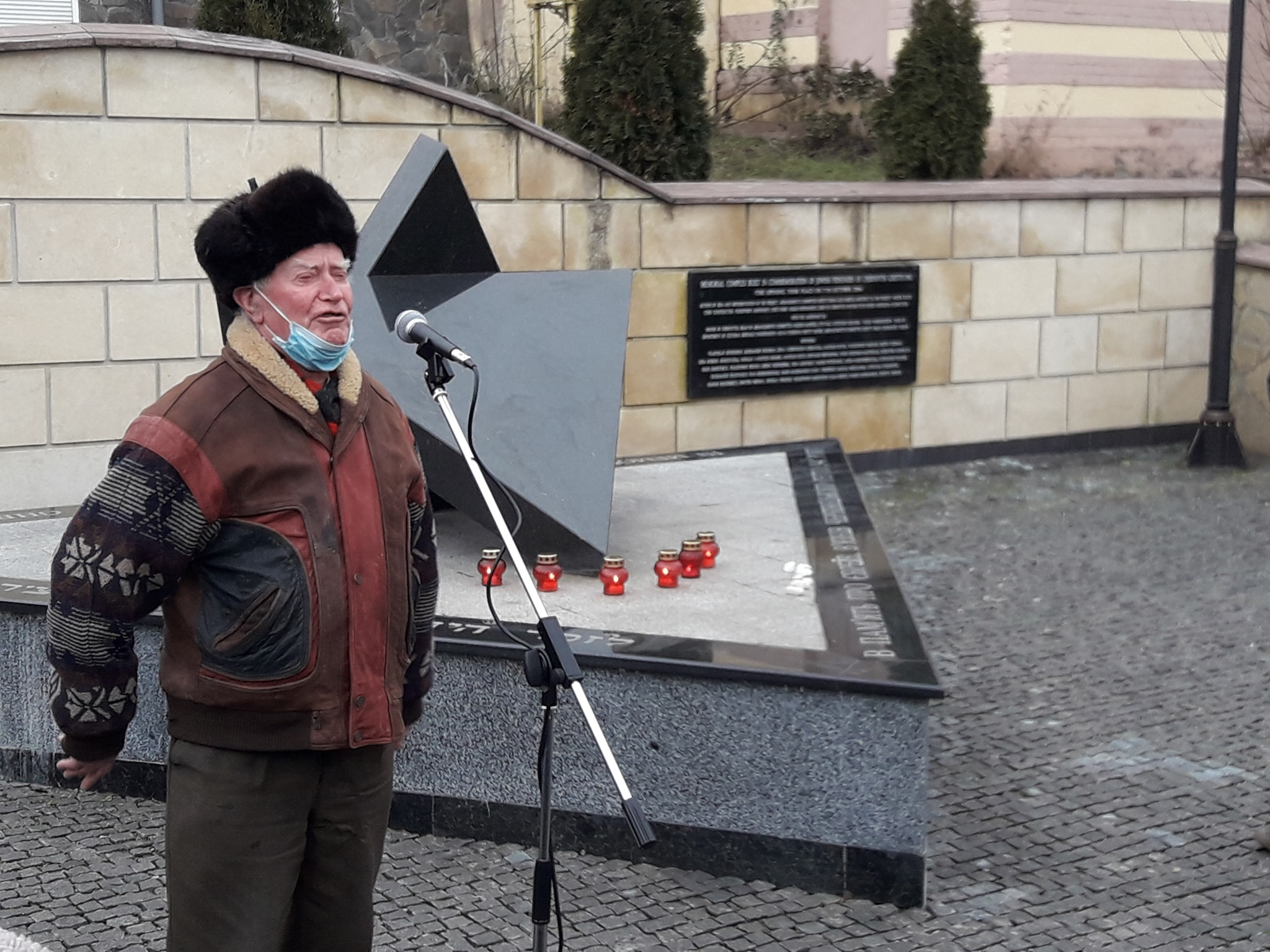
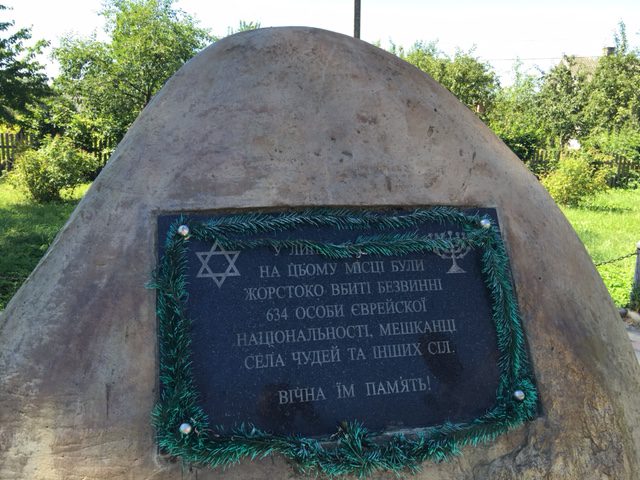
There is a memorial on the site of the mass murder, located about a block or two from the town centre, next to a Primary School.

We were transported by 2  guides, originating In Suceava Roumania and driving to the border where we walked into Ukraine and met a Ukrainian driver. The border has long waits and therefore the idea to walk across the border both ways.

The road from Storozhynets direction is in much better shape, and although Google shows the more direct route as shorter time-wise, it is in very bad condition and actually takes longer. So, we recommend the longer route.

Not far from the centre of the village is a school for young children. Just behind the school there is a playground and next to it is a large memorial with a base in the shape of a Magen David.

                   The Memorial

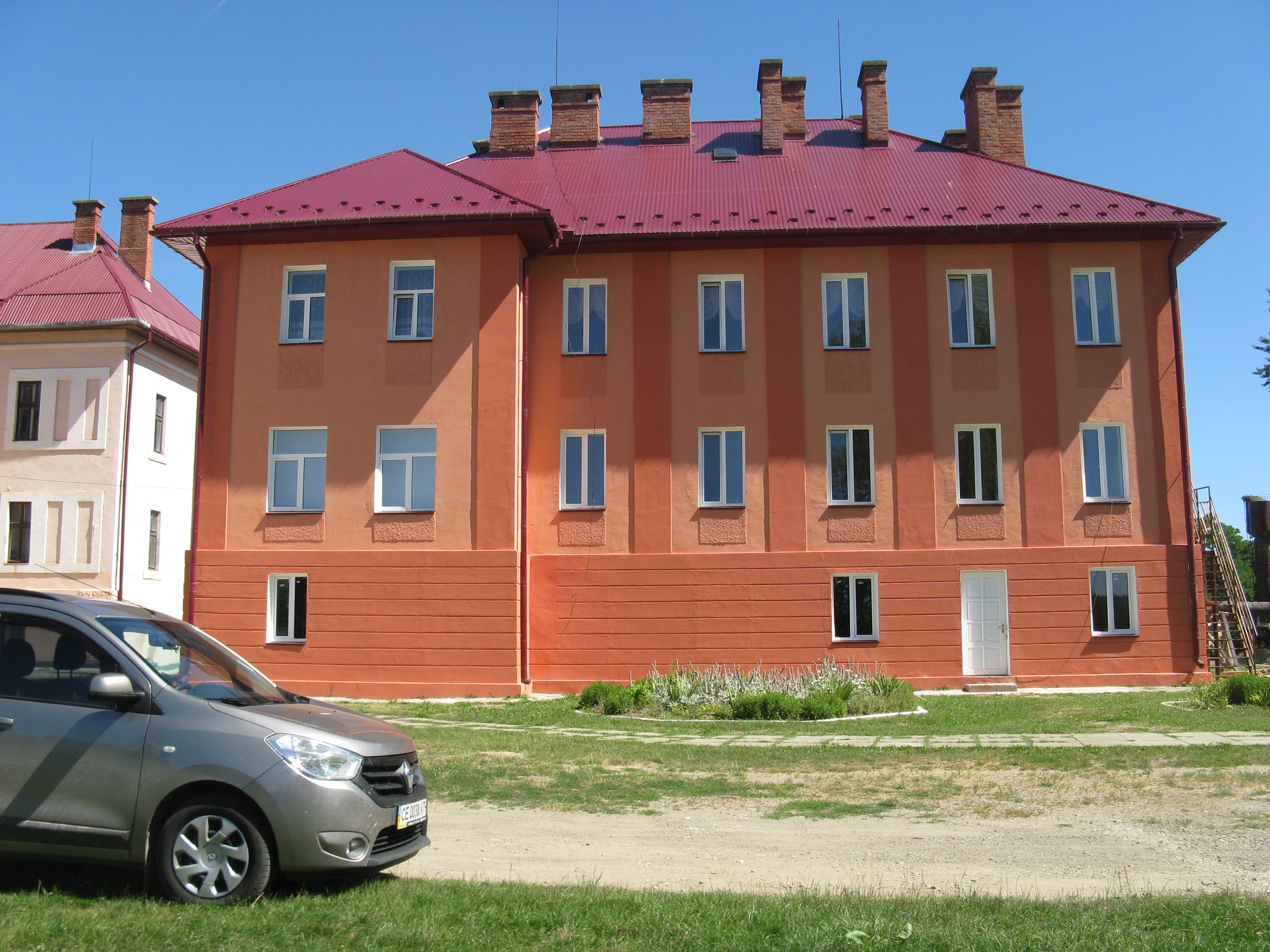
  The school. In 1941 – courthouse and jail


In that school site, in 1941 there was  a courthouse and jail. Sometime between July 3-5, 1941,  the 650 Jews of the town were locked into the main jail. Then our grandfather, aunts and uncles and cousins were shot and thrown into a mass grave behind the building.

My father Asiu Moses was hiding in the woods and escaped. His full story can be found at https://www.jewishgen.org/yizkor/Chudyn/chu001.html

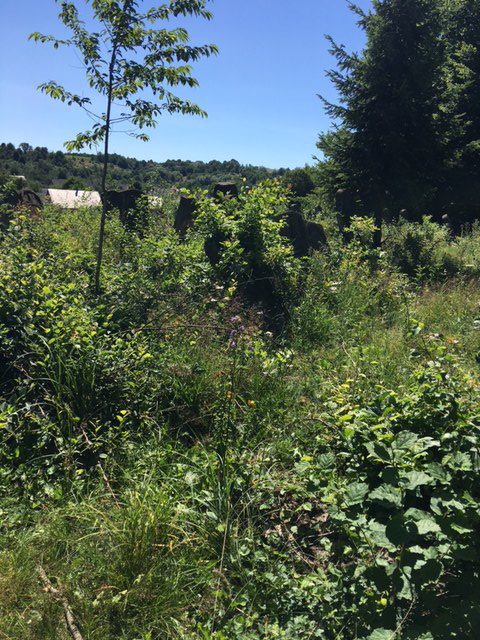
The original Jewish cemetery of Chudei is out of the village along the road, in the same direction from town as the memorial, a kilometre or two opposite to the Christian cemetery. It is very overgrown and many of the tombstones would require a large cutting tool to chop down the overgrowth.  The writing on many of the stones is difficult or impossible to discern. Many are in better shape and identifiable.